
Homeschooling while working is not a small undertaking. It asks you to balance responsibilities that often pull in opposite directions — deadlines, household needs, children’s learning, and your own energy. Many parents begin this journey wondering whether it’s even possible to do both well.
The reassuring truth is that many parents successfully homeschool while maintaining paid work, flexible jobs, businesses, or shift schedules. It doesn’t happen through perfection or constant productivity. It happens through thoughtful structure, realistic expectations, and systems that support the family rather than exhaust it.
This article shares practical strategies designed specifically for working parents — not idealised routines, but approaches that fit real life.
Let Go of the “School at Home” Expectation
One of the biggest sources of stress comes from trying to replicate a traditional school day at home. Fixed hours, continuous instruction, and rigid timetables often clash with work commitments.
Homeschooling does not require recreating school structures. Learning can happen:
In shorter focused blocks
During flexible hours
Across the day instead of in one stretch
Through independent activities
Through everyday life experiences
Children can make meaningful progress without sitting at a desk for six consecutive hours. In fact, many children thrive with shorter, intentional sessions combined with exploration and self-directed learning.
Allowing your homeschool to look different from conventional schooling is often the first step toward sustainability.
Build a Routine Around Energy — Not the Clock
Working parents rarely have the luxury of uninterrupted mornings dedicated entirely to teaching. Instead of forcing learning into fixed time slots, consider designing your routine around natural energy patterns.
Ask yourself:
When are you most mentally available?
When are your children most focused?
When is independent work easiest for them?
Some families find success with:
Early morning learning blocks
Afternoon catch-ups
Evening reading sessions
Weekend project work
Consistency matters more than timing. A predictable rhythm — even if unconventional — gives children stability while allowing your work responsibilities to fit alongside learning.
Prioritise the Essentials
When time is limited, prioritisation becomes essential. Not every subject requires equal daily attention.
Focus on core areas first:
Reading and comprehension
Writing and communication
Mathematics
Critical thinking
Other subjects can rotate throughout the week or integrate naturally through projects, documentaries, field experiences, or creative activities.
This approach prevents overwhelm while ensuring steady academic development. Depth often matters more than quantity.
Encourage Independent Learning Skills
One of the most valuable gifts working parents can give their children is the ability to learn independently. This doesn’t happen overnight — it develops gradually through guidance and structure.
You can foster independence by:
Providing clear daily task lists
Setting expectations before work begins
Teaching children how to check their work
Creating accessible learning spaces
Allowing ownership of progress
Even young learners can begin building autonomy with gentle support. Over time, independence reduces pressure on the parent and increases confidence in the child.
Simplify Planning
Complex planning systems often collapse under busy schedules. Instead of elaborate weekly overhauls, aim for streamlined preparation.
Helpful approaches include:
Planning one week at a time
Reusing successful templates
Keeping materials organised and accessible
Preparing learning blocks in advance
Setting realistic daily goals
Remember: A workable plan beats a perfect plan. Consistency builds momentum far more effectively than constant reinvention.
Use Small Moments Intentionally
Working parents may not always have long, uninterrupted teaching windows — but small moments add up more than they seem.
Learning can happen during:
Breakfast conversations
Travel time
Household tasks
Evening reading
Shared problem-solving
These interactions strengthen understanding and connection without requiring additional scheduling. Education is not confined to worksheets or desks — it often unfolds in everyday life.
Protect Your Energy
Sustainable homeschooling depends on parental wellbeing. Exhaustion does not serve anyone — and pushing beyond capacity can lead to burnout.
Consider building safeguards into your routine:
Accept lighter days when needed
Allow flexible pacing
Reduce unnecessary comparisons
Celebrate progress, not perfection
Rest without guilt
Energy protection is not neglecting education — it is protecting the system that makes education possible.
Stay Connected to Your Purpose
There may be days when the balance feels difficult. Returning to your “why” can restore perspective.
Many parents homeschool while working because they value:
Family closeness
Flexible learning
Individual pacing
Emotional wellbeing
Personalised education
Keeping sight of these motivations helps maintain confidence during demanding periods.
Homeschooling success is rarely measured by flawless days — it is measured by long-term growth, connection, and stability.
When Structure Helps — Seek Support
Sometimes, creating a rhythm alone can feel overwhelming. There is no weakness in seeking guidance or using structured resources.
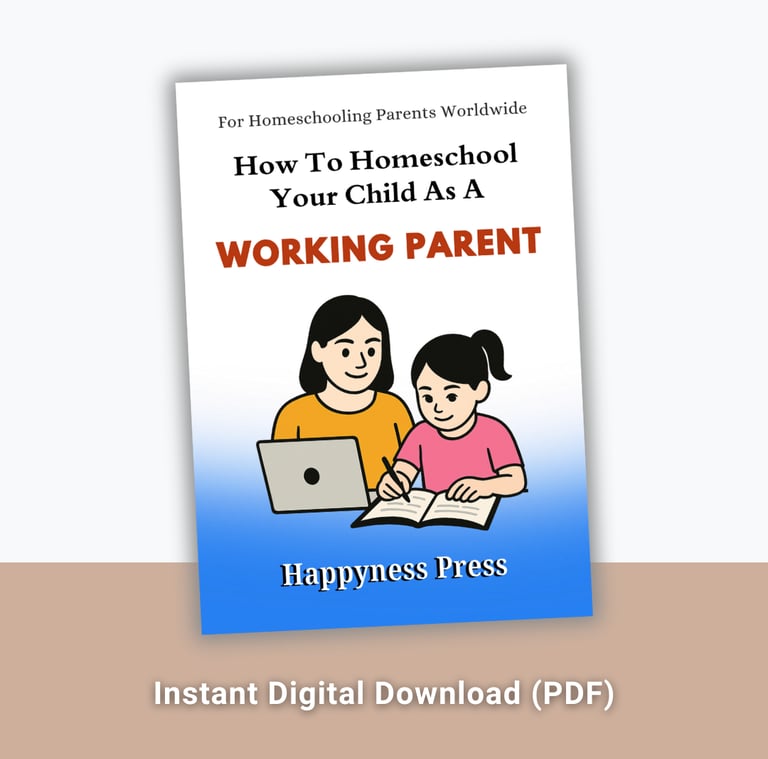
If you ever find yourself wanting a clearer framework, the eBook “How to Homeschool Your Child as a Working Parent” was created for families like yours in mind. It provides a complete working-parent homeschool system designed to help you:
Save time
Reduce overwhelm
Get clarity and structure
Establish a sustainable learning rhythm for your family
It’s intended as a practical companion — something you can lean on when you want a system with tools that support your real life as a working parent homeschooling your children.
Final Thoughts
Homeschooling as a working parent is not about doing everything perfectly. It is about building something functional, calm, and sustainable for your unique household.
With flexibility, prioritisation, and realistic routines, homeschool and work can coexist — not without effort, but without constant strain. Progress will come through steady adjustments, realistic expectations, and systems that support learning, work, and family wellbeing together.
There is no universal blueprint. But there are workable paths — and many families are walking them successfully every day. With patience, flexibility, and consistency, you can create a homeschool approach that belongs uniquely to your family as a working parent doing both roles with heart.
Homeschooling as a Working Parent: Realistic Strategies That Work
Recommended Articles





© 2026 Happyness Press. All rights reserved.
Happyness Press
Contact Us:
contact@happynesspress.com