
Homeschool burnout often sneaks up quietly.
You don’t wake up one morning deciding you’re done. Instead, it builds slowly — day by day — until even small things feel heavy. What makes it especially confusing is that burnout can happen even when you’re organised, committed, and genuinely trying your best.
If you’ve ever thought, “Why am I so exhausted when I’m doing everything I’m supposed to be doing?” — this article is for you.
Burnout Isn’t About Failure — It’s About Capacity
One of the biggest misunderstandings about burnout is that it’s caused by not doing enough, not trying hard enough, or not being disciplined enough.
In reality, burnout happens when the demands placed on you stay high for too long without enough space to recover.
Homeschooling places you in a unique role. You’re not just teaching lessons — you’re planning, adjusting, encouraging, managing emotions, tracking progress, and holding the overall rhythm of the household together. Unlike a typical job, there’s no clear “off switch.”
Even when you love homeschooling, that constant responsibility adds up.
Burnout isn’t a sign that you’re doing something wrong. It’s a sign that your energy has been stretched beyond what’s sustainable for too long.
Your Brain and Body Aren’t Designed for Constant Alertness
When you’re homeschooling, your mind is always slightly “on”:
Are we on track?
Is this child learning enough?
Should I change the plan?
What about tomorrow?
This ongoing mental alertness uses a lot of internal energy. Over time, your body responds to this constant pressure by slowing things down. That can show up as:
Fatigue that doesn’t go away with sleep
Brain fog or forgetfulness
Irritability or emotional overwhelm
Feeling unmotivated or detached
These are not character flaws. They’re signals that your system needs rest and balance.
Your body doesn’t know the difference between stress from danger and stress from responsibility. If there’s no regular pause, it eventually pulls the brakes.
Doing “All the Right Things” Can Still Be Too Much
Many homeschool parents are surprised to burn out because they’re doing things that are usually recommended:
Creating routines
Planning lessons
Setting goals
Tracking progress
Staying consistent
These are helpful tools — but they also require constant decision-making.
Every decision, even small ones, uses mental energy. Over a day, homeschooling can involve dozens of decisions before lunchtime. Over weeks and months, that adds up to mental exhaustion.
Burnout doesn’t mean these tools are bad. It means using too many tools at once — without enough recovery — can become overwhelming.
Sometimes the problem isn’t a lack of structure. It’s too much structure for the energy available.
Mental Load Is Invisible — But Powerful
One of the most exhausting parts of homeschooling isn’t what others see. It’s the thinking that never stops.
Mental load includes:
Holding plans in your head
Remembering who needs what
Anticipating problems before they happen
Adjusting constantly
Carrying responsibility even during “rest”
You may sit down at night and feel completely drained, even if the day didn’t look especially busy. That’s mental load at work.
Burnout often happens not because days are dramatic — but because nothing ever fully switches off.
Comparison Makes Burnout Worse
Even when you’re doing well, comparison can quietly undo your confidence.
Seeing other families:
Finishing more work
Using impressive systems
Appearing calm and productive
can create the feeling that you’re behind — even when you’re not.
Comparison adds pressure without adding support. It turns learning into performance and progress into judgement. Over time, this increases stress and reduces satisfaction.
Burnout grows faster in environments where you feel you must constantly measure up.
Burnout Isn’t Fixed by “Trying Harder”
When burnout sets in, the instinct is often to:
Push through
Add more planning
Tighten routines
Try harder to be consistent
But burnout doesn’t respond well to more pressure.
What actually helps is:
Reducing mental load
Simplifying systems
Allowing real rest
Letting go of unrealistic expectations
This doesn’t mean lowering standards or giving up. It means aligning your homeschool with human limits — yours and your children’s.
What Helps Prevent (and Ease) Homeschool Burnout
Burnout eases when you shift from constant output to sustainable rhythm.
Helpful changes often include:
Fewer decisions per day
Clear stopping points
Accepting “good enough” learning
Building in recovery time
Separating rest from guilt
Even small adjustments — like repeating the same weekly structure, reducing lesson variety, or planning fewer “extras” — can free up a surprising amount of energy.
Sustainable homeschooling isn’t about doing more. It’s about doing what fits.
A Final Reframe
Burnout doesn’t mean homeschooling isn’t right for you.
It means the current setup isn’t sustainable as it is.
Burnout is feedback, not failure. When you listen to it with care, it can guide you towards a calmer, more realistic approach — one that supports both learning and wellbeing.
You don’t need to do everything.
You don’t need to keep up.
You don’t need to prove anything.
You only need a homeschool that allows you — and your children — to keep going without losing yourselves in the process.
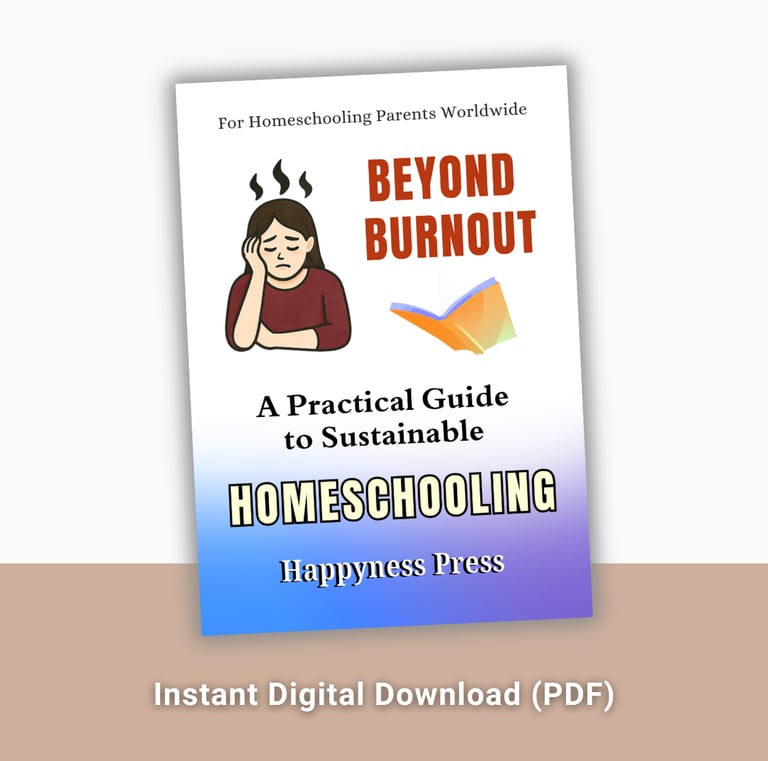
And if you ever need a quieter, more structured way to think through that reset, Beyond Burnout exists as a gentle companion — a homeschool burnout resource you can lean on when you’re ready.
Why Homeschool Burnout Happens
(Even When You’re Doing Everything Right)
Recommended Articles
© 2026 Happyness Press. All rights reserved.
Happyness Press
Contact Us:
contact@happynesspress.com