
Planning your first homeschool year can feel both exciting and uncertain. Many parents step into home education with enthusiasm, only to wonder how much structure they need, what authorities expect, and how to build a plan that is realistic for everyday life.
The reassuring truth is that planning a homeschool year in Australia does not require perfection or complex systems. It simply involves creating a thoughtful framework that supports learning while fitting your family’s rhythm. Every state and territory has its own administrative expectations, but successful planning focuses on clarity, flexibility, and sustainability.
This guide walks through practical steps to help parents begin their homeschool year with confidence.
Understanding the Purpose of Planning
Planning is not about scripting every lesson or predicting each outcome. Instead, it serves to:
Provide direction
Demonstrate intention
Reduce daily decision fatigue
Support registration requirements
Encourage balanced learning
A plan acts as a guide rather than a rigid schedule. It offers structure without removing the adaptability that makes homeschooling effective.
Especially in the first year, simple planning often leads to more consistent progress than highly detailed approaches that become difficult to maintain.
Know Your State Requirements
Because homeschooling in Australia is regulated by state or territory, planning should begin with understanding local expectations. While specific processes vary, most authorities request:
A learning outline or plan
Coverage of key learning areas
Evidence of ongoing education
Periodic review or renewal
Planning your year with these expectations in mind ensures smoother registration and review experiences.
This does not mean designing formal curricula — it simply involves showing thoughtful intention and engagement with learning.
Set Broad Goals for the Year
Before building schedules or selecting materials, it helps to step back and identify what you hope your child gains from the year.
Consider goals related to:
Literacy and numeracy
Curiosity and exploration
Independence
Emotional development
Practical life skills
These goals need not be detailed or rigid. They serve as a compass that guides daily learning decisions.
Goals can evolve — particularly in the first year — as parents observe interests, strengths, and challenges.
Choose a Planning Structure That Fits Your Family
There is no universal homeschool structure. Australian families commonly use approaches such as:
Term-based planning
Monthly outlines
Flexible weekly rhythms
Project-focused learning blocks
Many parents mirror school terms simply because it aligns with community rhythms and administrative expectations. Others design entirely personalised timelines.
The best structure is the one your family can maintain calmly and consistently.
Design a Gentle Weekly Rhythm
Instead of rigid timetables, many families benefit from a predictable rhythm that includes:
Core academic learning
Reading or writing time
Creative exploration
Outdoor movement
Life skills
Homeschool days rarely resemble classroom hours. Focused learning often occurs efficiently in shorter periods, allowing time for diverse experiences.
A rhythm creates stability while still allowing spontaneous discovery.
Select Learning Resources Gradually
New homeschool parents often feel pressure to acquire extensive materials immediately. Planning becomes more sustainable when resources are introduced thoughtfully.
Common starting points include:
Books and reading material
Basic maths supports
Writing tools
Educational games
Library access
As the year unfolds, parents refine their choices based on observation rather than assumption.
Homeschooling thrives on responsiveness rather than over-preparation.
Build Time for Record Keeping
Planning your year should include consideration of documentation practices. Maintaining records supports both personal reflection and compliance with state expectations.
This may involve:
Saving work samples
Maintaining learning journals
Tracking goals
Photographing activities
Including record keeping within your planning rhythm prevents backlog and ensures evidence is ready when needed.
Consistency matters far more than complexity.
Expect Adjustment Periods
The beginning of a homeschool year often involves experimentation. Families discover:
Which routines work
How long tasks realistically take
What motivates their children
Where flexibility is needed
It is normal to refine plans repeatedly during early months.
Planning should allow room for adjustment rather than treating initial designs as fixed commitments.
Confidence develops through experience.
Balance Structure and Flexibility
One of the most valuable planning skills is maintaining equilibrium between guidance and adaptability.
Too much structure may create stress or rigidity.
Too little structure may lead to uncertainty or inconsistency.
Balanced planning supports:
Direction
Freedom
Responsiveness
Calm progression
This balance strengthens over time as parents learn their child’s learning style and household dynamics.
Prepare Emotionally as Well as Logistically
Planning the first homeschool year is not only about schedules or resources — it is also about mindset.
Parents benefit from recognising:
Growth takes time
Confidence develops gradually
Mistakes are learning opportunities
Comparison with others is unnecessary
Emotional preparation helps sustain motivation and reduce pressure during transitional stages.
Homeschooling is a relationship-driven process rather than a performance metric.
Moving Forward with Clarity
Planning your first homeschool year in Australia involves understanding expectations, setting meaningful goals, building gentle routines, and allowing space for evolution. When approached thoughtfully, planning becomes an empowering foundation rather than an intimidating task.
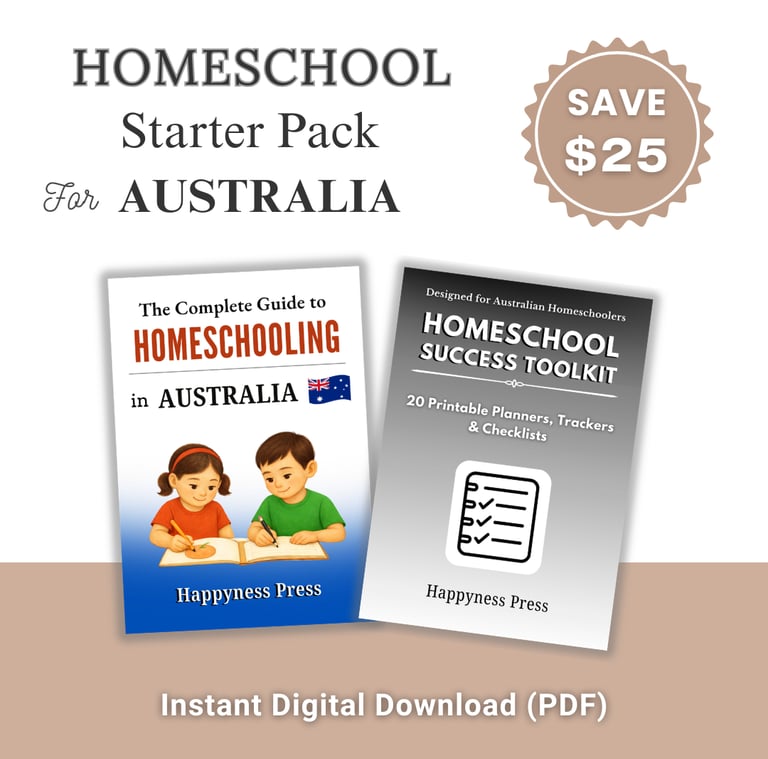
Many families feel more confident when they begin homeschooling with clear guidance and practical tools already in place. Having structured support from the start can make a meaningful difference — and this is where resources such as the Homeschool Starter Pack for Australia can be a genuine game changer. By bringing together essential orientation, planning guidance, and organisational tools in one place, it helps parents move forward with clarity rather than uncertainty. Instead of spending months piecing together information and systems independently, families can begin with a cohesive foundation that simplifies preparation and reduces overwhelm during those critical early stages.
Ultimately, a successful homeschool year is not defined by perfection but by steady engagement, adaptability, and intentional learning. Planning provides the starting map — but the journey unfolds uniquely for every family.
Planning Your First Homeschool Year in Australia
Recommended Articles
© 2026 Happyness Press. All rights reserved.
Happyness Press
Contact Us:
contact@happynesspress.com